Proposed Deschutes County measure would elect commissioners by ranked-choice voting

Oregon, county voters rejected a similar move in 2024: This time, it’s local.

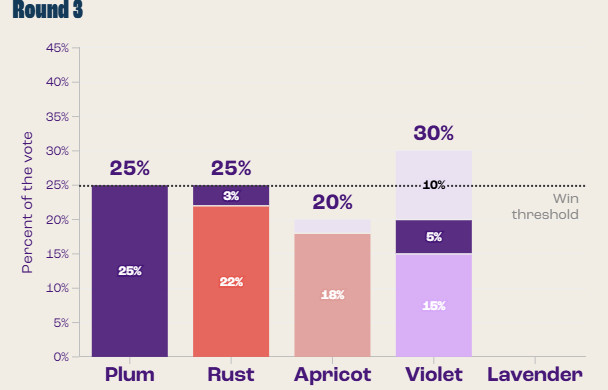
Part of FairVote.org’s explanation of how proportional ranked-choice voting works

Oregon and county voters rejected a similar move in 2024: This time, it’s local

BEND, Ore. – Nearly two years after Oregon and Deschutes County voters rejected a shift to ranked-choice voting, a new effort is underway to elect county commissioners in a similar manner that supporters say provides for fairer, more proportional representation for all voices, not just party favorites.

A coalition that includes the Deschutes Defend Our Democracy Coalition, Common Cause Oregon and the Tribal Democracy Project announced Monday they are launching “a new campaign toward fair elections and better representation in the county,” according to their news release.

County election officials have cleared the way for vote signature collection to qualify a measure entitled “Voices for All of Deschutes” for the ballot. They can take up to two years to gather the required 6,581 voter signatures, but are likely to shoot for an early August submission deadline, so it can make the November ballot.

If that happens, the measure would share the fall ballot with a proposal county commissioners sent to voters on a split 2-1 vote earlier this year that would create five geographic districts, each represented by one of the commissioners under the voter-approved expansion from three to five board members.

In November 2024, Oregon voters rejected a move to ranked-choice voting, Measure 11, 58 to 42 percent. That ratio was about the same for defeat of the measure by Deschutes County voters, who approved the board expansion from three to five members at that time.

Chief petitioners for the measure are Freddy Finney-Jordet, Amanda Page and Tawny Barin Howlett.

In a news release Monday evening, organizers of the new proposal pointed to the public discussion of various options since voters approved the board expansion, including “a system of proportional representation through multi-winner ranked choice voting.”

They said the current system “disenfranchises the vast majority of voters, and the more establishment elements of one party can control the whole board, leaving more progressive, rural and conservative voters without a voice.”

“Opponents to the district map on the November ballot argue it is a gerrymander that is likely to put the minority party in control of the commission, as well as deprive voters the opportunity of voting for every position on the commission,” the organizers said.

Here’s Fairvote.org‘s explanation of how Proportional Ranked-Choice Voting works, and here’s their video on the subject:

Eugene resident Brian Smith of the Tribal Democracy Project said he does most of his work in Central Oregon and has been helping organize the initiative effort.

Goal: ‘Bring more voices to the table’

Here’s what he and the chief petitioners had to say in their news release:

Smith said, “Proportional representation through ranked choice voting would eliminate the possibility of gerrymanders and reduce money and corporate influence in our local politics, bring more voices to the table, allow ALL voters to have a say in who is elected to the commission, all while being the system best equipped to protect the will of the majority of voters.”

Kate Titus, executive director of Common Cause Oregon, said, “Oregon has always led the way in making our democracy better, whether it be vote by mail or automatic voter registration. Recently, the U.S. Supreme Court has gutted the Voting Rights Act, and once again Oregonians have been leading the way throughout the state with proportional representation.”

Freddy Finney-Jordet, campaign manager for the Deschutes Defend Our Democracy Coalition, said: “Our system needs a change, so we don’t leave out entire groups of people.

“This initiative petition introduces proportional ranked choice voting for county commission races, which good government groups consider the gold standard of electoral systems for legislative bodies. Over 280,000 Oregonians across three counties have already successfully used this system.

“I was born and raised in Deschutes County – I know we’re facing a number of pressing issues as we grow,” Finney-Jordet added.

“To address affordability and livability, wildfire mitigation, and our land use needs, we need fair elections with community-driven candidates. By adopting proportional ranked choice voting, we can make that a reality for Deschutes County.”

Supporters of Initiative Petition 9-2026-I-01, entitled “Voices for All of Deschutes,” said they will host a campaign kick-off on Saturday, June 27th for local supporters to learn more and get involved.

Smith also provided this explanation of the benefits of proportional ranked-choice voting, from the Sightline Institute:

The complexity of the system can be daunting to explain the benefits of, but Smith told us the odds of success improve when the focus is on better outcomes and representation. He said there was a high degree of skepticism in Portland, for example, but once they used it, polling found people were “very supportive of this system.”

“I tend to think everything is new, until it’s not,” Smith explained, pointing out how at a national level, the Electoral College System can be hard to explain or understand.

While supporters only have until August 5th to gather signatures to meet the November election filing deadline, Smith said they could wait, but see benefits in “the political environment right now.”

Smith acknowledged that he is a progressive, but added, “I don’t think that’s a good system. I don’t think it’s good for democracy.

Why shift the commissioner election to the fall and not hold a spring primary anymore?

“The problem with the primary is that no one votes, in comparison to the general election,” Smith said.

But what if the new measure makes the ballot – and both its “at-large” commissioner election and the five-district map were to win voter approval? Smith said they will be speaking to the secretary of state’s office “very soon, but historically, to my knowledge, the one with the most votes is the one that prevails.”

Smith also acknowledged that it would be a new challenge for county clerks, as it’s a more complex system. But he said Ireland – where they refuse to use machines to count ballots – have been doing ranked-choice voting for a century,

“The people who have used it are happy, after the fact,” Smith said. “There’s no perfect system, but we feel this is the best system to address this issue.”

“We haven’t made 100 percent the decision” to go for the fall ballot, he said. “Collectively, a lot of us want to get this on the November ballot. But we also know we have to ‘read the room.’”

“Our focus is on the voting experience, which is fantastic,” Smith said. “People love using that (system),” as opposed to ones “where one single voice dominates and feeds into this hyper-polarized environment.”

How can we move forward – not sideways?

I often get myself in serious trouble with the anti-government folks on KTVZ.COM’s article comments by saying that media – or more precisely, journalists – like government, can’t “win” these days – that we’re damned if we do, damned if we don’t and damned if we can’t decide, that people believe we’re in our professions for the lowest of instincts (“Sensationalism!” “Ego trips!”) and not for “the greater, community good.”

So please permit me to expound a bit on what I mean (otherwise known as “digging myself a deeper hole”;-)

Of course, there are “winners” or “losers” in both professions (with us it’s about ratings and ad revenues, with politicians it’s votes and campaign contributions). Does that make us inherently bad, not to be trusted? I humbly submit, the answer is “no.”

To be sure, neither government nor the news media have a rosy image these days. We’re seen as exploiters, as people who don’t care about the impacts we have on everyday folks’ lives, who “use” others for our own means. If media would just expose the government’s (and big business’s, heck, everyone’s!) wrongdoing and nasty doings – if term limits would just “throw the bums out” – we’d live in a nirvana, a utopia – and woe befalls anyone who doubts those views.

To be certain, there are some in our professions – like every profession – who live up, or more precisely down, to those broad-brush stereotypes. But many others who try to do our best, and for the most part, are worthy of respect and attention. Separating the two is easier said than done. Your “bum” could be my “hero,” and vice versa.

But it’s hard not to say the current low opinion of public servants and reporters/editors is also a matter of hypocrites playing the public’s heart strings like a Stradivarius. Many things bring this to mind – the conservative talk show hosts who dominate the airwaves but rail against the “mainstream media” (if you’re on 20 hours a week or more, why aren’t you now “mainstream”?) and, of course, against the current administration as well.

If there’s one thing I appreciate about Glenn Beck, for example – despite the fact the few times he’s talked about something I have personal knowledge of, he got the facts wrong – is that he says he was railing against the White House policies before the current occupant. Portland radio host Lars Larson also does the same thing, sometimes confounding those who expect him to toe any particular conservative line by saying “this issue is different.” That’s right, think for yourselves, people!

Other commentators bemoan the ever-higher levels of not just partisanship, but poison partisanship, in which all the ills of one’s own life and that of our communities can be blamed on … somebody. Illegal aliens. Government bureaucrats.  Politicians who raise taxes for fun and just don’t listen to the people (as if the people all speak with a unified voice!)

I also get myself in constant trouble for playing the role of devil’s advocate – of saying the answers are not as simple as some would have you believe, that there are unintended consequences to most “solutions” (Sheriff Joe’s Arizona “tent city” jail comes to light – if it were that great, and not a lawsuit magnet, why wouldn’t other law enforcers follow in their footsteps? Because, of course, they are egotistical empire-builders!)

Which brings me to an idea I’ve debated in my mind and sometimes, with others, for many a year – the idea made possible by technology of moving to a more true democracy, rather than a republic, one in which the Internet affords all of us an opportunity to weigh in on and help make decisions on public issues large and small. If we dare.

But would a direct Internet government short-circuit the political egos and the lobbyists greasing the skids (and their own palms) to get what they want? Or would it turn into something like Wikipedia – so complex that, while anyone can take part, only a relatively small clique of participants do much of the heavy lifting?

Or worse yet, would every issue become one where WE are played like a Stradivarius – where community decisions ultimately are decided based in large measure on who has the best spokesman, the guy/gal with the best teeth/hair promoting their position on this issue or that? A mix of “American Idol” and C-SPAN, fighting for attention and participation in a celeb culture?

Health care reform is a prime example – a good majority of the public say we want “reform,” but the definition and consensus is as elusive as Bigfoot – and just as dangerous, should we encounter it. The devil is always, always in the many, many details.

So how about this – anyone can have a voice (oh, the cacophony!) in this direct online government, but only those who pass a test on knowledge about the subject can weigh in with their votes? Again, the devil’s advocate in me sees big trouble with that – who writes the test, who sees a slant in one direction or another on or between the lines, etc. etc.

Besides, who among us has the time or inclination to read 1,000-page bills on every issue we expect government to address? And what will those “executive summaries” leave out? No, we want to leave it to government to figure it out.

So, we’re stuck with a situation where many of us, for example, hate Congress but love our congressman or woman. Where we blame government and the media for things like the recession – saying we were in cahoots to rah-rah growth and bubbles that always burst, and didn’t warn (the media’s role) or prepare us for/head off (government’s role) the inevitable tailspin.

 No wonder we’re so frustrated! We want change, but break down over whether this or that “change” is what “we” meant.

 If I have any hope, it’s that a cause will emerge at some point to find a hero of moderates and a platform, not of issues, but of how to reasonably, sensibly approach them – that extremists from either end of the spectrum are equally distrusted, as they should be – that we prize, teach and promote critical thinking of the kind that can keep us from becoming anyone’s “sheeple.”

If I created a social network promoting such a viewpoint, would it bring attention, scorn or derision? (Or apathy?) People trying to tear it down, or those trying to build it up and advance something beyond today’s petty wars of attrition and frustration?

I must also speak up on behalf of that much-maligned journalistic goal of objectivity. Everyone has an opinion, so let’s have it out in the open! I weigh in at times, with the comments on our Website, but I try like heck to keep them out of the news articles I and others write.

People need impartial summations of the various views/proposals before us, and if that’s so-called “he said she said” journalism, I plead guilty to this artificially created “crime.” I don’t want newspaper editorials to tell me what to think, much less the articles in print, on the air or online. Commentary, clearly labeled, is wonderful, marvelous. But in “straight news” stories, please just provide me the information and let me make up my own mind!

As usual, I sure don’t have the answers. But as a reporter, my goal always has been to ask the right questions, and not be fooled by simple answers to complex questions. And to ask follow-ups, and not start writing until I understand the issue well enough to relate it to others, in as simple a manner as possible.

I guess it all boils down, in the end, to whether you think the media, the government or anything else is made up of fallible, all-too-human people who are just trying to get through the day/week/their lives, who have good intentions and motives, and sometimes (Frequently? All the time?) screw up – or if you see “them” instead as evil, lazy, manipulative, etc., etc.

If Anne Frank, before the Nazis cut short her life, can write that she still believes, after all, that “people are good, at heart,” why can’t we? Is that really seen as childhood naiveté, rather than a sane, simple way to go through life – not gullible, but not stone-hearted either?

Isn’t there a balance? Isn’t there a middle ground? There has to be. Or we’re sunk.

In a way, what the Internet has done is empowered ALL of us to be journalists – to research and sift through the information, apply critical thinking skills and decide for ourselves if there’s a position/proposal we can get behind on the issues of the day.

As Pogo the comic-strip once famously said, “We have met the enemy, and he is us.” Can we admit that to ourselves, and try to learn from it?