Oregon and county voters rejected a similar move in 2024: This time, it’s local
BEND, Ore. – Nearly two years after Oregon and Deschutes County voters rejected a shift to ranked-choice voting, a new effort is underway to elect county commissioners in a similar manner that supporters say provides for fairer, more proportional representation for all voices, not just party favorites.
A coalition that includes the Deschutes Defend Our Democracy Coalition, Common Cause Oregon and the Tribal Democracy Project announced Monday they are launching “a new campaign toward fair elections and better representation in the county,” according to their news release.
County election officials have cleared the way for vote signature collection to qualify a measure entitled “Voices for All of Deschutes” for the ballot. They can take up to two years to gather the required 6,581 voter signatures, but are likely to shoot for an early August submission deadline, so it can make the November ballot.
If that happens, the measure would share the fall ballot with a proposal county commissioners sent to voters on a split 2-1 vote earlier this year that would create five geographic districts, each represented by one of the commissioners under the voter-approved expansion from three to five board members.
In November 2024, Oregon voters rejected a move to ranked-choice voting, Measure 11, 58 to 42 percent. That ratio was about the same for defeat of the measure by Deschutes County voters, who approved the board expansion from three to five members at that time.
Chief petitioners for the measure are Freddy Finney-Jordet, Amanda Page and Tawny Barin Howlett.
In a news release Monday evening, organizers of the new proposal pointed to the public discussion of various options since voters approved the board expansion, including “a system of proportional representation through multi-winner ranked choice voting.”
They said the current system “disenfranchises the vast majority of voters, and the more establishment elements of one party can control the whole board, leaving more progressive, rural and conservative voters without a voice.”
“Opponents to the district map on the November ballot argue it is a gerrymander that is likely to put the minority party in control of the commission, as well as deprive voters the opportunity of voting for every position on the commission,” the organizers said.
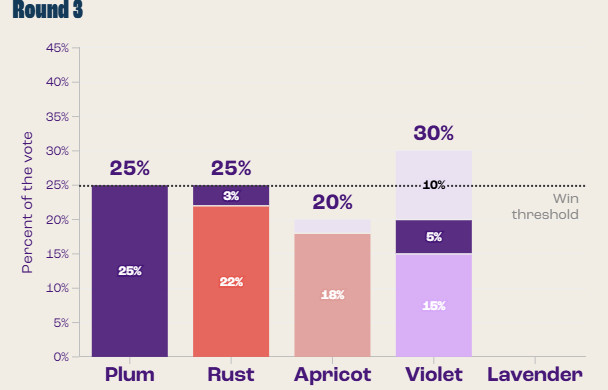
Here’s Fairvote.org‘s explanation of how Proportional Ranked-Choice Voting works, and here’s their video on the subject:
Eugene resident Brian Smith of the Tribal Democracy Project said he does most of his work in Central Oregon and has been helping organize the initiative effort.
Goal: ‘Bring more voices to the table’
Here’s what he and the chief petitioners had to say in their news release:
Smith said, “Proportional representation through ranked choice voting would eliminate the possibility of gerrymanders and reduce money and corporate influence in our local politics, bring more voices to the table, allow ALL voters to have a say in who is elected to the commission, all while being the system best equipped to protect the will of the majority of voters.”
Kate Titus, executive director of Common Cause Oregon, said, “Oregon has always led the way in making our democracy better, whether it be vote by mail or automatic voter registration. Recently, the U.S. Supreme Court has gutted the Voting Rights Act, and once again Oregonians have been leading the way throughout the state with proportional representation.”
Freddy Finney-Jordet, campaign manager for the Deschutes Defend Our Democracy Coalition, said: “Our system needs a change, so we don’t leave out entire groups of people.
“This initiative petition introduces proportional ranked choice voting for county commission races, which good government groups consider the gold standard of electoral systems for legislative bodies. Over 280,000 Oregonians across three counties have already successfully used this system.
“I was born and raised in Deschutes County – I know we’re facing a number of pressing issues as we grow,” Finney-Jordet added.
“To address affordability and livability, wildfire mitigation, and our land use needs, we need fair elections with community-driven candidates. By adopting proportional ranked choice voting, we can make that a reality for Deschutes County.”
Supporters of Initiative Petition 9-2026-I-01, entitled “Voices for All of Deschutes,” said they will host a campaign kick-off on Saturday, June 27th for local supporters to learn more and get involved.
Smith also provided this explanation of the benefits of proportional ranked-choice voting, from the Sightline Institute:
The complexity of the system can be daunting to explain the benefits of, but Smith told us the odds of success improve when the focus is on better outcomes and representation. He said there was a high degree of skepticism in Portland, for example, but once they used it, polling found people were “very supportive of this system.”
“I tend to think everything is new, until it’s not,” Smith explained, pointing out how at a national level, the Electoral College System can be hard to explain or understand.
While supporters only have until August 5th to gather signatures to meet the November election filing deadline, Smith said they could wait, but see benefits in “the political environment right now.”
Smith acknowledged that he is a progressive, but added, “I don’t think that’s a good system. I don’t think it’s good for democracy.
Why shift the commissioner election to the fall and not hold a spring primary anymore?
“The problem with the primary is that no one votes, in comparison to the general election,” Smith said.
But what if the new measure makes the ballot – and both its “at-large” commissioner election and the five-district map were to win voter approval? Smith said they will be speaking to the secretary of state’s office “very soon, but historically, to my knowledge, the one with the most votes is the one that prevails.”
Smith also acknowledged that it would be a new challenge for county clerks, as it’s a more complex system. But he said Ireland – where they refuse to use machines to count ballots – have been doing ranked-choice voting for a century,
“The people who have used it are happy, after the fact,” Smith said. “There’s no perfect system, but we feel this is the best system to address this issue.”
“We haven’t made 100 percent the decision” to go for the fall ballot, he said. “Collectively, a lot of us want to get this on the November ballot. But we also know we have to ‘read the room.’”
“Our focus is on the voting experience, which is fantastic,” Smith said. “People love using that (system),” as opposed to ones “where one single voice dominates and feeds into this hyper-polarized environment.”
 Leave it to Barney