Blessed by three special mentors (and lots of other help) along the way

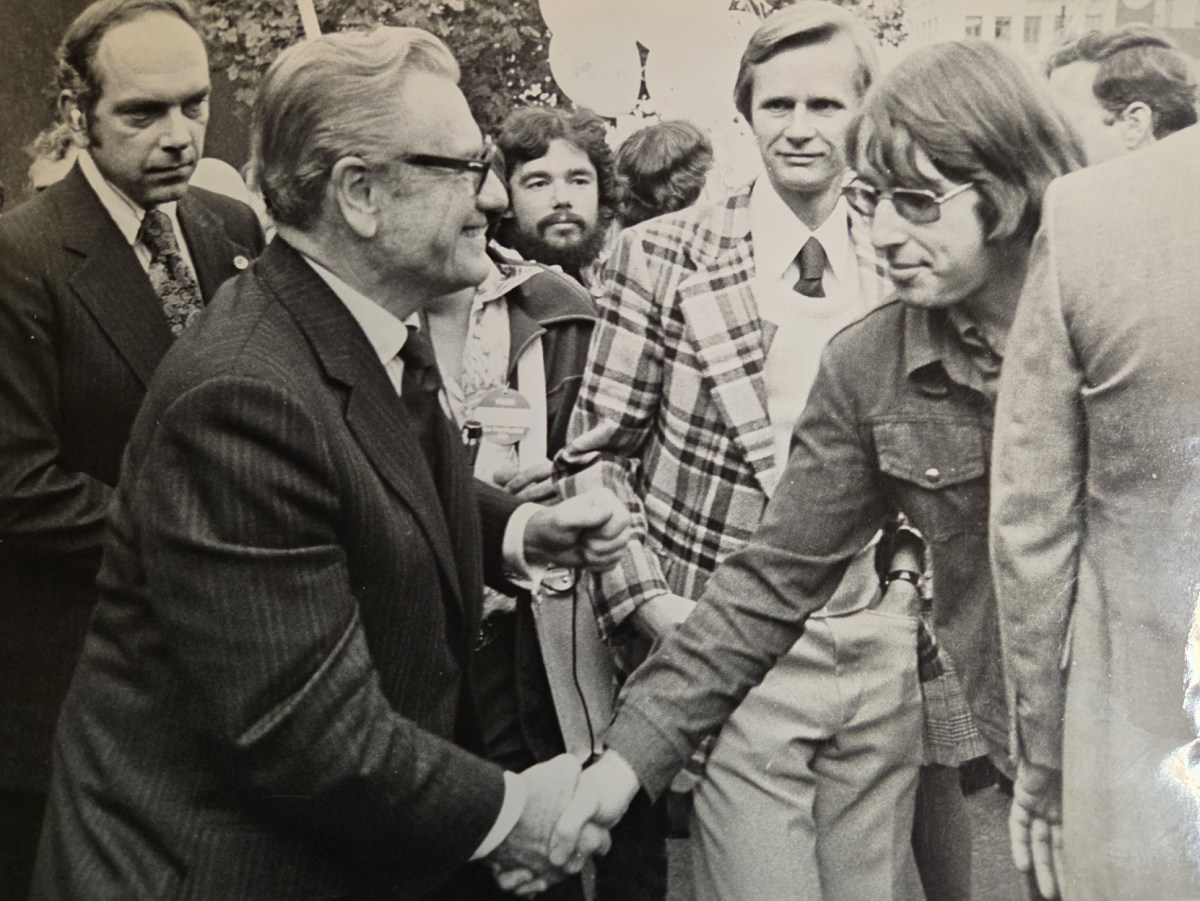
I got to shake the baby-smooth hand of Vice President Nelson Rockefeller when he visited Portland.

Wow, I haven’t posted here since my early December a-fib two-night hospital stay, my first since, oh, chickenpox/measles as a very little boy? Fortunately, I got better fast when they switched me from a bad to a good pill and in time for Deb’s Stage 4 cancer battle that’s still ongoing.

But I digress, as always;-)

Blake Timm, a communications guy at my alma mater, Pacific University in Forest Grove, spotted a comment I made on a recent LinkedIn thread regarding my early career, and three special mentors that… well, here’s what I said:

Oh I always have tons of stories, you know me! But the most important of my life was the connection between two mentors, actually three. First was from Chuck Heil at John Adams High School to Fred Scheller at Pacific, then from Fred to Billy Joe McFarland, the UPI Portland bureau chief. That led to my nearly full senior year internship with UPI and the start of my journalism career. Because as I like to tell people, it’s not what you know or who you know – it’s both! I owe a lot to those three great mentors.

Blake asked to tell him more about that, so instead of just emailing him some thoughts, I figured it was worth a blog post – so here goes:

I’ve been blessed many times, before my career really began and ever since, by folks who helped me move on to the next step.

When my family arrived in Portland in early 1970, I and my three brothers began to attend John Adams High School, which drew national headlines and had just opened up a few months earlier, as four Harvard educators were sort of handed the school to test new methods of education. (Which felt like it was mostly sitting in a circle at our desks as teachers said, “What do you want to do today?” Yeah, one of those;-)

I had been writing up news at school since second-grade home room (my mimeographed – make that purple, dittoed masterpiece: The Room 210 Tooter).

But this high school was a wow in so many rabbit-hole ways, I have to fight digressing. (Some folks buried a car engine behind the school on the very first Earth Day, in 1970. The students also voted NOT to have a Rose Festival Princess. The next year, we had to.)

The most special spot for me was where Chuck Heil oversaw the daily TV news show we did, and I was the editor-in-chief. KWAP (Kids With a Purpose, but yeah) was the first of its kind. Even though it was black and white, we all learned a lot about how to put on a news show, from the set with a rear-screen projector to a very early, spendy portable video recorder, the Sony Portapak, which I seem to recall was about $1,200, so Chuck said: “If it falls, fall under it”;-)

Chuck somehow – I’ve forgotten these details, too -had or made a connection with TV/radio professor Fred Scheller at Pacific, and so I was able to go there, starting in the fall of 1973.

Fred was another great guy – very involved in the large contingent of Hawaiian students, who put on an amazing annual luau. We all learned the basics of TV and radio especially, and I can still see his smiling face and hearty laugh.

I became manager of the campus radio station, KPUR, for a year or two – no one could really hear the thing, but we painted the studio blue and moved up from a beast of a gold tube-powered “board” – from KEX I believe – to a cool, small QRK board with colorful LED lights, the whole shebang.

I did have other summer jobs during my college years – one summer, staying in the basement of Mac Hall and working for Charlotte Filer, writing for Pacific Today, the alumni magazine, helping paste newspaper clippings in a scrapbook with rubber cement, etc. Another summer I wrote news releases for the local hospital. (My first paying job actually was before college, in 1972, working in housewares, toys and bikes at the original G.I. Joe’s in north Portland.)

Again, I’m not sure how the connection happened in those pre-Facebook/LinkedIn days, but Fred reached out to Billy Joe McFarland, manager of the United Press International wire service’s downtown Portland bureau.

They arranged for me to spend my senior year as a full-time intern for UPI, starting there in the fall of 1976.

I could write a book about my 15 years with UPI, as we scrappy “Unipressers” took on the mighty Associated Press – and we logged the newspapers to help compile national logs that showed whether UPI “won the play” over AP, with the motto: “Get it first, but get it right!”

For that amazing school year (broken up by a 3-week stint back in “Frosty Grave,” under the 7-7-3 school calendar Pacific was using), I got to report for UPI, asked President Ford a question at the Portland Air Base during his re-election fight with Jimmy Carter, and lots more great memories.

Billy Joe wrote glowing progress reports on my behalf to Fred, and I still have the copies in my home-office file cabinet. I was quite the long-haired hippie then, but I wasn’t alone;-)

I got paid the princely sum of $50 a month for bus fare from my off-campus apartment to downtown Portland. I remember coming home and watching Mike Donahue on KOIN-TV reading MY WORDS on Newsroom 6! (I said I’d rather be doing the writing than sitting there reading it, later realizing he got paid a wee bit more than $50 a month;-)

Those were the days. But I owe a lot to Chuck Heil (and a great speech teacher, Bob Gerber, and the Adams Unity newspaper’s overseer, Jim Rice), and to Fred Scheller (and there, the wonderful speech professor, Hap Hingston) and then to Billy Joe McFarland at UPI, where I worked with a great group of news teachers and mentors, including Bobbie Ulrich and Clyde Jabin – Clyde was the guy who “named” D.B. Cooper, by the way.)

My career has had its ups and downs – whose hasn’t? – but these wonderful guys gave me a chance to do what I loved for a half-century or so – break the news and tell people’s stories – or as I like to say, helping others tell their stories and trying to stay out of the way.

I often say it’s not what you know, or who you know – it’s both. I owe a lot to the special people who helped me along the way.

Trial by (wild) fire: pride, weariness – and thanks

I have other things I could do – tons of pretty weekend sunset/other pics for example, but just wanted to thank all of our friendly loyal viewers and online visitors for your kind words over the past wildfire-ravaged week.

It means a lot. To all of us.

Our long hours are nothing compared to a) the backbreaking work done on the lines by firefighters (yes, they are paid – still, I’d never do it, so dangerous!) and b) the fear, concern and worry of those threatened by the flames – which so far have not included the heavily populated areas of the High Desert.

So far.

I just read a national story that 1 million acres are burning in the Northwest – the most at any single time in the region’s history. And it’s not even late July — what will happen when the traditional peak of the wildfire season hits in August?

I shudder to think – I don’t want to think. (And with the long hours, the thinking is a bit addled anyway;-/

Which reminds me – I tested something over the weekend, said so on Facebook – and those who weighed in gave it a thumbs up.

For much of the week, as the number of fires and their size grew, I tried to keep a roundup of them written, plus post the many great reporter stories from the lines, fire camp etc.

But it was getting ridiculous. So… while I do a LOT of cutting-pasting of well-written news releases on the Web in “normal” times — for Community Billboard, even top stories — I moved to doing so with the releases coming from the management teams on the various major fires.

They don’t all write, organize or format their releases alike, but they’re usually pretty good – and while I do skim and make sure things aren’t messed up, posting the releases in full DOES get the info out quicker – and makes sure that every closed forest road, trail, campground etc. makes it online.

Sure, InciWeb (a wonderful site even with its shortcomings) has most if not all of the info (plus maps etc.) – which is why we link to their info – but we also aim to be the place to turn for the latest info – so this is a happy medium between trying to rewrite a lot of already available info and just sending you off to somewhere else. Call it “semi-curated info,” or whatever.

While talking of burnouts ON fires – there’s the other kind of burnout this week could portend for the near future (we’ll be praying for rain if this keeps up – I’m sure some already are). So if we’re not quite as cheery as usual when we pick up the phone or respond to an e-mail, please understand that, while we’re not out there digging fire lines, we’re all trying to keep up with the constantly changing picture of our bad wildfire season, and bring it to you in as timely a manner as possible.

But I have to compliment my colleagues – veterans and new arrivals all – for some great fire coverage this week, from every angle. I’m sure they have more energy/stamina than older Yours Truly, and it looks like they’re going to need it:-/

And again, thanks for the support and kind words. I think we all hope for some “boring” news days soon. I know I do!


Riding the tide of the daily news (and helping others float their boat)

I often tell people I ride the tide of the daily news.

And that means I often have less than full control over where the day takes me — because you can never know exactly what’s going to come into the e-mail box, pop up on the police scanner or just… happen. (Like an ER doctor, but thankfully with a lot less blood and … stuff;-)

Some days that look to be busy as heck fizzle. Some quiet days blow up fast.

Ever since second grade and the mimeoed (remember mimeograph machines? How about ditto machines?) Room 210 Tooter, I’ve loved telling folks what’s going on.

Part and parcel of how we hear about stuff is the lowly (hey, they get little respect but are vital) news release (which of course is usually e-mailed but — we still get the occasional fax. Fax machines – long gone, so they are turned into Adobe PDFs auto-magically;-)

Ask just about any Central Oregon police officer or fire official, and odds are after we get such a release, I’ll be one of, if not the first calling or e-mailing to fill in holes, ask a follow-up question or find out something more specific than say, “vehicle.” (Bleh.)

My list of Press Release Pet Peeves has been so longstanding, there’s probably a version buried in the (ahem) bowels of this very blog.

Things like — don’t say what year something is going to happen, even near the end or beginning of the year — that’s so obvious in the vast majority of cases. But please DO put in what day of the WEEK it will be – that helps folks know whether they can attend your event or not. Don’t make them look it up on a calendar.

Titles are only capitalized immediately BEFORE a name, not after. Stuff like that. (Give up the two spaces between sentences — or heaven forbid, double-spacing the lines — those kinds of things died with the typewriter and grizzled newspaper copy editors with red pencils. And know your its and it’ses. And try not to let your organization develop it’s own quirky style, like capping the “City” of Bend (it’s not the only city!) or having to cap “County” every time in a release. Why? And ease back on the Acronyming of America (A of A). (Oh, and “Oregon’s Senator Jeff Merkley?” There are 2 senators from Oregon. Or is that a dig at your fellow Democrat?;-)

Oh, and PR folks: I know you want to make personal relationships happen, but if you send something only to one person in a 20-person newsroom, it WILL be the day they are off – or worse yet are the ancient un-updated media lists that send to people and places long gone — in some cases, dearly departed, even. That’s really worth the time and investment. Better to use the generic e-mail address, like stories@ktvz.com for our newsroom. Several people check that and will route it properly.

I’ve thought many times about a sideline business of helping folks get the basic style and grammar hurdles out of their releases, so folks can focus on the content.

But when you ride the tide of the daily news, it’s pretty much all-consuming, just to stay in the boat, not have it flip and keep it pointed downstream, ready for whatever rapids, swirls and eddies lie ahead.

And don’t forget that life jacket!

Back to the Future: Loving Magazines Again

A quick note to say how much I love my Nook Tablet (when I can tear myself away from the keyboard to read on it.)

Books? A few. Web? Yep, looks fine.

But I’ve always been a magazine junkie, and had faltered and let many lapse because of my hoarding instincts, and also because of all those pesky renewal mailings, oy did I grew to despise those seemingly weekly nag-mails!

But on the Nook, not only are the magazines cheaper, but you pay by the month (feels cheaper and usually is), and it comes out of your account. No muss, no fuss. (I recently did the same thing with finally re-upping with OPB. Makes me feel good watching every Nova, Nature or Frontline again;-)

Anyway, some mags are smart and make it easy to get the Nook version of their magazines for free if you pay for the print subscription (which I’ll admit feels dumbly redundant but I understand the economics are … unsettled.)

That’s how I get Time, and Newsweek, and Wired. But I’ve also signed on for ones I’ve meant to read — The Atlantic (great long-form writing), Reader’s Digest (which keeps reinventing itself and is just plain fun), and geekfests like PC Magazine (which went digital-only years ago and is looking all tablet-spiffy in its latest redesign.)

Oh, and the last Newsweek, with Mad Men (not a fave show but hey…) on the cover, was completely done in 1966 look, right down to the ads. Mix of new info and nostalgia, so cool!

And I just read my first issue in years of U.S. News and World Report (remember that one?) and while it has a smidge of the light stuff, it’s straight-ahead Washington, D.C. news and … well, it’s a newsmagazine, not one big piece of fluff. Love it.

I told the kind folks at Barnes and Noble there’s just one thing you can’t get on it: The time away from work to enjoy it. But I’m trying!

D.B. Cooper: How Some Typos Become Legendary

I was still a sophomore at John Adams High in Portland when the skyajcker forever known as D.B. Cooper dropped into history.

But five years later, I was working beside the man who named him. A man you’ve never known, but who was a funny, gentle man and a heck of a good reporter at United Press International in Portland.

His name: Clyde Jabin. And he was on duty the late-November night in 1971 when Cooper — shown on the passenger list as Dan Cooper — demanded all that money and two parachutes, and … well, the rest of the story is pretty well known.

What’s not as well known is how “Dan” became “D.B.”

In a time when wire services were the principal method of news disseminated far and wide, long before the Web etc., UPI was the David to the mighty non-profit Associated Press, which meant we had to outhustle the AP folks every day, running for our survival.

Anyhoo, as my mentor and friend, the bureau manager at the time, Billy Joe McFarland re-related for no doubt the umpteenth time on an e-mail list many of us former Unipressers are part of, Clyde was on the phone with an FBI agent and taking down the hijacker’s name. He apparently asked, on hearing the name, “D as in dog, or B as in Boy?” or somesuch. Whatever the answer was over that phone line, he typed both initials, and it went from notes to article to the wire (still sent to newsrooms around the world by clattering teletypes – remind me to tell you the “joy” of changing those ribbons some time) – and into history.

Just about every article that noted the two names over the decades has practically sneered at how the mistake became “fact,” through an “error” by UPI.

Anyone who’s worked in a wire service and has churned out the tons of articles we have (and they still do) knows that being your own editor is a tightwire without a safety net that can leave you swinging in the wind at times.

But from all I remember of the kind, gentle Clyde Jabin from the years I knew him, he didn’t let his unfortunate small role in history make him angry or bitter. He laughed it off, because, after all, to err is human, etc.

To make history with a mistake is far from unique. But Clyde, who died several years back in a tragic car crash, was just one of the memorable characters at UPI who I’ll always remember for their competitive spirit, the place where more than anyplace else you just had to keep running at a steady pace to keep up with all the stories to write and chores to perform (typing up the midday markets, changing the paper and those dang ribbons, answering calls of every kind – hmm, still do that, and it’s still as fun at times and exasperating at others;-)

That competitive drive and enthusiasm instilled at a young age has stood me in good stead, as it did this week when I got a neat little award from my boss at work. (I Facebooked it and was humbled by the outpouring of congrats).

I’ve made far more than my share of typos and mistakes in my writing over the years. Fortunately, it’s been a pretty small percentage of the number of stories that have been pounded out on this keyboard or that.

But I’d like to dedicate a little piece of that clear plastic award to Clyde and all the fine folks who have helped me and put up with me in all those years in journalism. I’d like to think Clyde is some place special now, where he got an exclusive interview with the real ‘Dan Cooper,’ who told him:

“Just call me D.B. – everybody does, thanks to you.”

My Words Are My Children

My wonderful wife (my biggest blessing for 28 years now) and I have never been blessed with children. Cats, yes, and they’re great, but… I once in a while think all the many thousands of words and stories I’ve written are my children, in a way, sent out into the world – good, bad, rushed or well-composed – to have their impact and make their way.

And much like kids, sometimes my words and articles do me proud, and other times they turn on me, when I haven’t given them the time and attention they deserve. Fortunately, with words, there can be do-overs of sorts, but on the Net, older versions can live on, so it pays to be careful;-)

I also think of the younger folks I work with – whom I see, alas, far more than my real family, living in other areas – as the people I can affect and influence into the future, bit by bit, answering their questions, editing their scripts (sometimes over-editing, for sure) and just generally showing an insane work ethic and things like that, that hopefully can rub off on them in positive ways as they make their own lives and careers happen.

So through a LinkedIn post I found this – the Tao of Journalism pledge – and it was so nice to see others in this media-blaming, government-blaming world try to find a common set of principles that are simple, not high-falutin and easy to understand. Honesty, transparency, accuracy – the things I cling to, to get by on a harried news day – all summed up nicely.

I hope things like that catch fire, and as I’ve written many a time, that we move beyond the Blame Society and the finger-pointing to find all things we do agree on.

America doesn’t stand for your side ‘winning.’ but listening to the other side, incorporating its best ideas and coming together to move forward. If that sounds like a blowhard politician, so be it. If we lived up to such a mission, rather than paying it lip service, maybe we’d get something done rather than simply know who to blame for what isn’t getting done.

Those who feed on fear, hate and divisiveness don’t deserve your time or attention.  The trolls who grab the microphone to, in essence, spit on those who provides it should be called out for what they are. Those who believe their political side, their view are the One True Way for a perfect society are misleading themselves and being used.

In My Humble Opinion.

Yep, if all of us only hated those who are filled with hate, we wouldn’t have a kumbaya Utopia – ain’t gonna happen – but at least we could have civil, rational discussions about very tough problems.

There I go again, off on the same ol’ tangent. Oh well, even if no one (or few) are listening, it feels good to state it.

Maybe one day there’ll be THAT kind of political movement, and we can get over the idea that any one politician will transform society. It’ll have to be us. And that’s a good thing.

Exclusives can happen oddly

“Stephen Trono’s on the phone for you!”

Ted Taylor, our 6pm show producer, saw my jaw drop to the floor when I entered the newsroom and he said that.

Thus began a mad scramble to get a phone-recording system running so we could talk – and we did, for almost a half-hour.

I’ve written all about that at the Website but one thing Stephen – we’re not close friends, but we’ve talked over the years – wanted me to know, about why he called me.

This Bend developer who’d been shot five (or is it six?) times by his wife – and lived, and is still with her – had been back in Bend and able to speak since mid-October.

Why hadn’t he talked to any reporters? Because not a single one called him to ask if he’d talk!

Seriously. I mean, he could be fibbing, but why fib about that?

I know reporters have this all-too-often reputation of rushing up to someone who’s house is burning down, sticking a microphone and camera in their face and saying “how do you feel watching your life ruined?”

Or something like that.

But the words “sensitive” and “journalist” are not mutually exclusive.

This was just a very vivid reminder that we should never, ever assume someone does NOT want to talk. And should always make the attempt. The worst that can happen is screamed obscenities in your ear and a hang-up on the other end of the phone line.

I think I’ve quoted the grizzled old editor’s line here before: “If your mother says she loves ya, check it out!”

Point being, it’s worth those hang-ups for the one time someone says, “Finally, I’ve been waiting for someone to ask me!”

But that has to be the first time I can recall in a local, high-profile story that someone, after months of waiting for someone to call them, called me. I’m sure glad it was me, of course, and the final chapter of this somewhat bizarre tale has yet to play itself out. But as I approach 20 years in Central Oregon, sometimes just being here the longest (and trying my hardest always to get it right while getting it first, and trying to be fair and accurate) can bring good stories my way. and I’m grateful for that.

Right and wrong and speed, 1981-2011

Man, deja vu and not in a good way.

AP quoted NPR and CNN (if I remember correctly) in reporting an Arizona congresswoman’s death after a mass shooting.

She did not.

No doubt, there will be mass dissection of how the mega-error happened, but what will be just as sadly interesting is how, 30 years after the Reagan assassination try and AP’s in-error report of James Brady’s death (I worked for UPI, which got it right), such a rare, major human breaking-news error is still possible — but that the world of the Internet spreads the error far and wide in milliseconds.

Drat. Humans will make mistakes, and communication errors will exist as long as there are humans.

But the much greater speed of today’s communication networks means even more care and caution must be used before unsubstantiated info is spread around the globe.

Whatever the specifics may be, this will be another excuse to blame the media as sloppy and reckless. When really, all we are is … human.

Mistakes are big or small. This one is very big, and very sad, and … never 100 percent preventable. But boy do we have to keep trying.

‘I don’t know how you sleep at night…’: Journalism Ethics 101

Wow, what a week. Awful, tragic news — and editorial judgment calls for our news staff.

On the one hand, it’s ‘exciting’ and energizing to have breaking news to cover, in an area where we blessedly have relatively little major crime, etc. compared to bigger cities.

Still, it can be frustrating when people think we make every decision based on whose lives we can invade or pain we can exploit.

It’s not true, but to be defensive in such situations only makes a difficult situation worse.

When someone dies in an awful way, we need to try to tell how they died – but more importantly, how they lived.

We don’t, contrary to the critics’ claims, go ringing up or knocking on the door of every crime victim, stick a camera and mike in their face and say, ‘How do you feel?”

The worst calls I’ve ever made are to folks in pain. I always hope and pray a family friend or representative will answer the phone, that those dealing with tragedy have been helped by others who are taking our inevitable calls for a photo, word of a fund in their name, etc.

A Bend man died this week in an example of the awfully named term, ‘Freak accident’ – a tree slammed down on the van in which he was sleeping. A Roseburg TV station kindly shared photos clearly taken hours after the discovery (tree was off the van and cut up etc.)

Still, it was shocking. Not graphic or lurid, but jolting.

We used the photos. A few close friends asked ‘have you no shame,’ etc.

After a day, I removed the photos from our front page. I can always see both sides of these things. The image was known, and to put his smiling face there again seemed right, and we followed with another story talking to friends about how he lived.

Then there’s the awful possible murder-suicide in Bend.

Facebook has two sides for people – the private one only friends can see, and the public one anyone can see using a search box.

We found two heartbreakingly normal photos of the family on the mother’s and father’s Facebook pages.

We used them and soon heard from a very upset family member.

I tried, best I could, not to get defensive, and to explain why we felt they were OK and even good to use – again, as I say, to show how folks live, not just how they die.

It didn’t end with a slammed-down phone, so I should be grateful.

But then came the note today, saying “shame on you” and asking why we felt it was OK to put the photos (and names – hey, we waited almost a full day to use the names, when property tax records indicated the homeowners and the paper felt fine running that right away – we waited until police issued the names to be sure family members were notified first.)

But Facebook is a public source of info, and we wanted to share MORE than names – to tell who these people are. In the immediate aftermath of tragedy, that is a very difficult time to glean those details, and we’re more successful in some cases than others.

But I hope that, God forbid, I ever face such a tragedy, I’ll understand why the media is doing what it’s doing – unless we/they cross the line, and then I also hope I’d make my point without lashing out. But it’s human, and we all are that.

We don’t revel in others’ pain, nor wish to intrude on a family’s grief. I have been deleting many comments that go too far in supposition or worse (man, there are some scary folks out there). But … it’s tough, and we have to try to be both sensitive and consistent. I hope and pray most folks understand that.

The ‘right’ to use info or a photo or the like doesn’t always clash with the issue of ‘rightness’ (propriety), but it can. Just now, police passed along the family’s request to remove info gleaned from public Facebook pages from the story. They are distraught, but I can’t help thinking they have far bigger things to be distraught about.

These were not damning or in any way negative pieces of information about the family – in fact, they were heartbreakingly normal and upbeat. But of course, I removed them, after touching base with the news director on his call on the issue.

But as I said, it’s ‘right’ vs. ‘rightness.’ Tough balancing act for all concerned in such terrible cases.

May you never be in such a situation – but may you also think about it whenever you make info publicly available, intentionally or otherwise. As society and the definition of privacy evolves, maybe, just maybe it’ll be less of an issue. I’m not expecting it, though.

Of Typos and Corrections (Glass Houses, Stones, Etc.)

Karma can be a thing of wonder.

Picked up the morning Bulletin off my sidewalk and opened it up to find a P. 1 headline that reads: “How do local kids fair at COCC, Oregon universities?” (Side note: I wish our Web provider would go to downstyle headlines rather than Capping Most Words. But I digress, as usual;-)

Anyway, I chuckled a bit at the prominent typo (they meant how do those students fare not fair) – as I often do when others show they are human, or a group of humans who are not perfect in catching such things (though most of us are always better at catching other folks’ typos than our own. We don’t fall in love with our words, necessarily — but they sure look right to us!)

So I thought I’d blog a bit about the issue today – but before I could get around to doing that, wouldn’t you know but … last night, in writing up a Crime Stoppers story about a stolen painting, I said the thing was 30-by-30 feet.

Whoops.

As one of several article commenters on the screwup pointed out, “30 by 30 feet is a wall.”

Uh, yep. The TV script simply said “30-by-30.” I added the dumb error.

And the other day, in writing up President Obama’s upcoming Oregon visit, I typed “White” but left out “House.”

Heh;-/

Some point out typos kindly, others do so in slamming fashion: “Don’t you have any editors over there?” (Well, yes, but a lot of my online writing is edited by … me. Dangerous, huh?) Or “Don’t you ever use spell check?”

Why yes, but that only goes so far. Spell- or grammar-check wouldn’t catch the wrong measurement term, or the missing word “House.”

For all the technological advances of the world, there’s some things only humans can catch. Or not catch.

So I always try to politely respond, something like “Oy vey, yes, that was bad, sorry, fixed, thanks,” etc.

And many are kind enough to say that, with the volume of words I put out in a day, I do pretty darn well, typo-wise.

To the others, I quote my John Adams High School mentor Chuck Heil’s little coat-lapel button from all those years ago: PBPGINFWMY.

“Please Be Patient – God Is Not Finished With Me Yet.”

You, neither;-)